
01 / The organization
Supporting a distributed media workforce
This global digital media and entertainment company creates and distributes content across digital platforms, social media, streaming television, and print. Its estimated 501–1,000 employees include a distributed workforce in the United States and India.
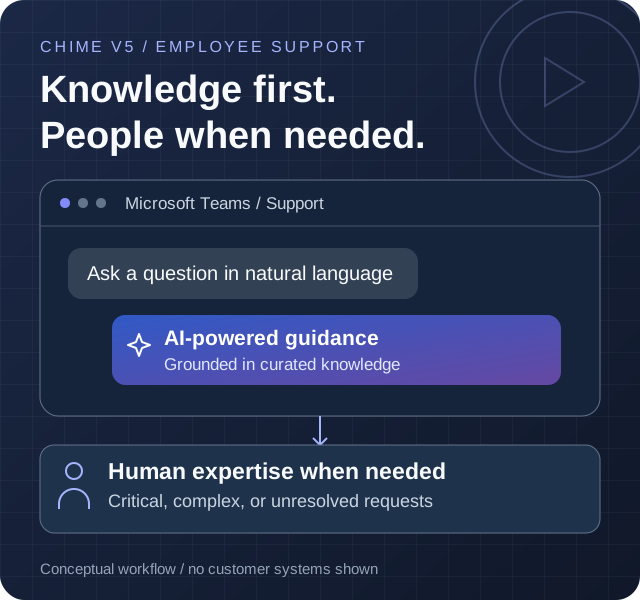
Chime V5 brings a knowledge-driven employee helpdesk into Microsoft Teams, combining AI-powered self-service with access to a specialized human support team.
02 / The story
Making existing knowledge accessible to employees
A team of 10 specialized agents handled employee support requests. The organization had developed a curated knowledge base covering approximately 90% of incoming support queries, but that information was not always surfaced effectively when employees needed it.
The goal was to make existing knowledge easier to access through a conversational self-service experience while keeping human expertise available for critical, complex, or unresolved requests.
03 / The story
Moving beyond an agent-dependent helpdesk
Employees relied on an agent-dependent helpdesk even though the organization had already invested in a substantial knowledge base.
The supplied account does not identify a previous support platform or provide a measured before-and-after baseline.
04 / The story
Knowledge-driven AI self-service in Microsoft Teams
All employee support chats start in Microsoft Teams. Chime V5 offers an AI-powered helpdesk where employees can ask questions in natural language and receive guidance drawn from the organization's curated knowledge base.
The self-service-first workflow brings relevant knowledge into the conversation to help employees address common issues independently. When a request is critical, complex, or not adequately addressed through self-service, it can be escalated to the 10-member human support team.
The approach makes existing knowledge more accessible while reserving human expertise for requests that need additional attention.
Start in Microsoft Teams
An employee opens a support conversation in the familiar collaboration channel.
Ask in natural language
Describe a question or issue to the AI-powered helpdesk.
Bring knowledge into the conversation
Use curated organizational knowledge to guide self-service.
Escalate when needed
Connect critical, complex, or unresolved requests to the human support team.
05 / The story
Reported chat activity, self-service, and guest ratings
The supplied operational summary reports approximately 40 inbound chats per day. At that rate, 1,200 chats over 30 days is a projection, not a verified calendar-month total.
The summary reports that 90% of inbound chats were addressed by AI self-service and 10% connected to human agents. These are reported shares; underlying counts, reporting dates, and the criteria for an AI-addressed chat were not supplied. They do not establish an independently verified resolution rate.
Average speed to answer is reported as under 30 seconds, but its measurement basis was not supplied; it is not a guarantee for every chat. The summary also reports that 88.35% of submitted guest ratings were five-star. The rating response count and full distribution were not supplied.
Reported employee support results
Chat activity, self-service, and guest feedback
Reporting period not supplied
About these results and how they were calculated
The supplied summary reports approximately 40 inbound chats per day, 90% of inbound chats addressed by AI self-service, 10% connected to human agents, average speed to answer under 30 seconds, and an 88.35% five-star share of submitted guest ratings. No dated dashboard export, underlying chat counts, rating response count, or rating distribution was supplied. The definition of an AI-addressed chat and the answer-time measurement basis were not supplied.
Approximately 1,200 chats is a 30-day projection calculated as 40 daily inbound chats multiplied by 30, not a measured calendar-month count. The AI and agent shares do not establish independently verified resolutions. Average speed to answer is not resolution time and does not mean every chat was answered within 30 seconds.
06 / The story
How knowledge and human support reach employees
Employees enter through Microsoft Teams. Chime V5 brings the organization's curated knowledge into an AI-powered conversational self-service experience, with escalation to human agents when needed.
This is a conceptual view of the supplied support journey, not a network or security diagram. The underlying AI provider, knowledge-base platform, and other integrations were not specified.
Microsoft Teams
Employee support entry point
Chime V5
Conversational self-service and human escalation
Curated knowledge base
Existing organizational guidance for common support queries
AI-powered assistance
Knowledge-driven responses to natural-language questions
Employee self-service
Guidance for common issues in the conversation
Human support team
10 specialized agents for requests needing additional attention
Chime V5 technologies and features
- Intelligent chatbot workflows
Bring self-service and human assistance together in a support workflow.
- Route to Agents
Connect requests needing further attention to human agents.
Microsoft technologies in this solution
- Microsoft Teams (opens in a new tab)
The employee entry point for all support chats.